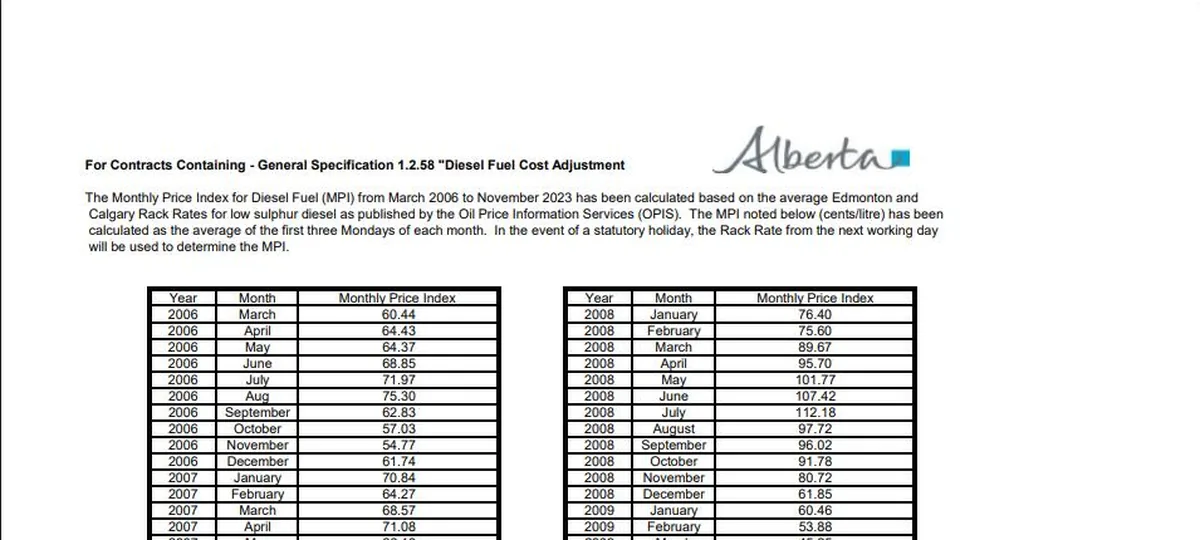
Alberta Transportation and Economic Corridors publishes a monthly diesel price index for its own fuel adjustment clause. It is the cleanest public record of what you have been paying at the rack. In January 2026 the index was 103.54 cents a litre. In September it was 212.29. The retail number Statistics Canada tracks for the same purpose was 208.05 in August. Whatever your card lock shows, the rack has doubled since the season started.
Here is what that does to an hourly rate, and then the four mechanisms that exist to recover it, and the one place they do not reach.
What a dollar a litre does to a machine
A 160 horsepower excavator working normally burns somewhere around 20 litres an hour. At the $1.32 a litre the ARHCA guide carried into 2026, that is about $26 an hour of fuel inside the rate. At $2.12 it is about $42. The difference is $16 an hour, $160 a ten-hour day, and about $3,500 a month for one machine on a 22-day month. A tandem on the haul burns less per hour but runs more of them. The BC Ministry’s hired equipment program uses 15 litres an hour for on-road and 35 for off-road equipment, and those are fair planning numbers.
If you have four pieces of iron on a county job that you priced in January, the fuel line is costing you roughly what a labourer costs. That is the size of the problem.
1. ARHCA’s 2026 fuel surcharge: a flat adder, one table for the year
On May 4, 2026 the Alberta Roadbuilders and Heavy Construction Association issued a cost-recovery fuel surcharge as an addendum to the 2026 Equipment Rental Rates Guide. It is a public one-page PDF on the ARHCA product page. You take the published hourly rate and add a flat amount by the machine’s net horsepower:
| Net horsepower | Added per hour |
|---|---|
| 0 to 150 | $7.75 |
| 151 to 300 | $16.75 |
| 301 to 450 | $25.50 |
| 451 to 600 | $32.75 |
| 601 to 750 | $44.00 |
| 751 to 900 | $62.25 |
| 901 to 1,050 | $72.50 |
| 1,051 to 1,200 | $83.50 |
It does not move month to month. It was set in May against the guide’s $1.32 basis, and diesel has gone up a good deal since, so by September the surcharge is recovering part of the gap, not all of it. It applies wherever the contract pays “ARHCA rate”: Alberta Transportation extra work under clause 1.2.33.2.3, Alberta Infrastructure cost-plus work, and most county force account once you show them the page. Alberta Wildfire pays the guide rate but its 2026 directive does not mention the addendum, so ask before you add it to a fire invoice.
2. BC Wildfire Service: a monthly adder per machine class
BC Wildfire Service strips fuel out of the rate entirely. Its All Found rate is machine, operator and attachments, excluding fuel and lubricants. Fuel comes back as the Market Fuel Adjustment, a dollars-per-hour figure for each equipment class and each calendar month, posted within a week of the month starting, built from the previous month’s average rack price in BC. You add it to your own invoice. It is not paid on standby, and if a job runs across two months you can use the higher month for the whole of it.
The October 2026 sheet shows what a year like this one does. The smallest excavator class, under 65,000 pounds and 160 horsepower, carried a fuel adjustment of $46.11 an hour in January and $86.07 in October. That is on top of a $206.54 all found rate. Nobody argues about it because the number is printed on a government PDF every month.
3. BC Ministry of Transportation and Transit: hired equipment, adjusted monthly
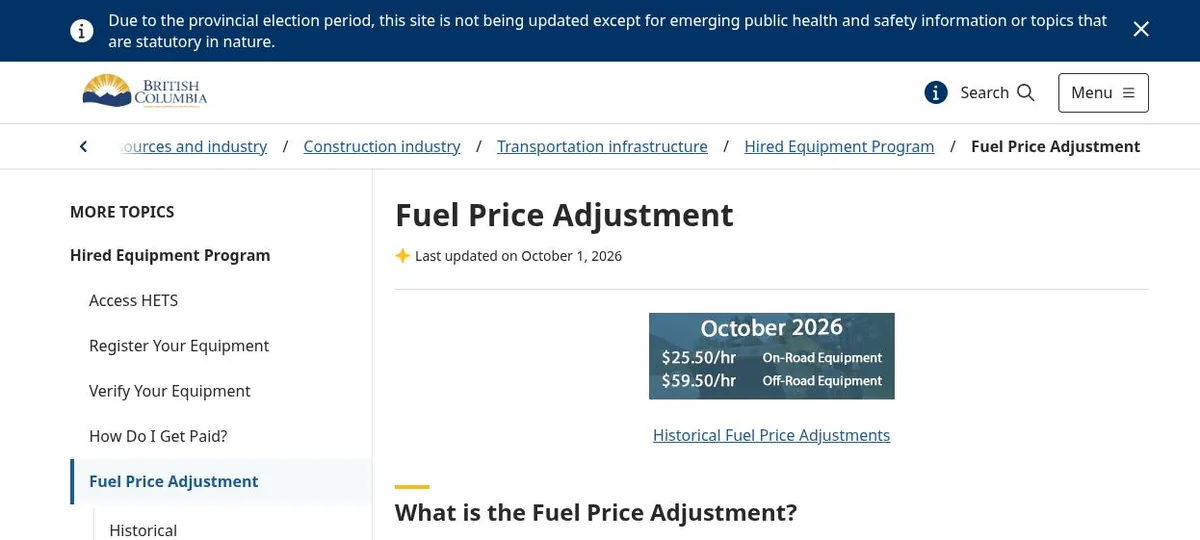
The Ministry’s Hired Equipment Program pays the Blue Book All Found rate plus a fuel price adjustment that it posts within five days of each month starting. The base is $0.94 a litre from the fall of 2009. The adjustment assumes 15 litres an hour on-road and 35 off-road, multiplies by the difference between this month’s price and the base, and adds the result to the hourly rate. For October 2026 that is $25.50 an hour on-road and $59.50 off-road. The Blue Book itself says its published rates are subject to that monthly adjustment, and a few sections of the book are marked no fuel, where you bill the fuel directly instead.
4. Alberta Transportation’s diesel fuel cost adjustment: big jobs only
This is the one that sounds like it should help and mostly does not. Alberta Transportation and Economic Corridors has a Diesel Fuel Cost Adjustment clause, 1.2.58 in the General Specifications, with a standard special provision that switches it on. The rules:
- It applies only when the Special Provisions say so, and only to grading over 150,000 cubic metres, asphalt over 30,000 tonnes, granular base over 35,000 tonnes, or combinations of those. Never to a lump sum item.
- The Base Price Index is the Department’s monthly index just before the tender was advertised, stated in the Special Provisions. The Monthly Diesel Price Index is the published index for the month the work was done, counted from the 26th of one month to the 25th of the next.
- Nothing happens while the monthly index sits between 85 and 115 per cent of the base. Above 115 you are paid the excess; below 85 you rebate it.
- The adjustment uses fixed consumption rates, not your burn: 1.6 litres per cubic metre of grading, 0.5 litres per tonne of crushing and stockpiling, 2.8 litres per tonne of asphalt in place, 2.4 litres per tonne of granular base in place. Haul is inside those numbers. Burner fuel is never adjusted.
So a job advertised in January 2026 with a base of 103.54 and grading done in September at 212.29 is at 205 per cent of base. The clause pays the part above 115: 0.90 times the quantity times $1.0354 times 1.6 litres. On 200,000 cubic metres that is roughly $298,000. On a 40,000 cubic metre county job it is zero, because the clause was never in the contract.
Read the base index in the Special Provisions before you price a highway job. If the tender was advertised in a cheap month and you are building in an expensive one, the clause is worth real money. The reverse is also true.
5. Municipal and private work: usually nothing
Most town, county and developer contracts in Alberta have no fuel clause. Unit prices are fixed for the life of the job and the risk is yours. Three things I do about that:
- Say which month’s diesel the price assumes. One line in the covering email or the clarifications: “Pricing assumes diesel at the September 2026 Alberta Transportation index of 212.29 cents per litre.” It does not change the contract. It does start the conversation if the number moves another 50 cents, and it protects you when somebody asks later why your haul rate looked high.
- Keep the price validity short. Thirty days, not ninety, when fuel is moving. An owner who sits on a tender for four months in a year like this one is asking you to carry their risk.
- Check the haul quotes. Gravel and trucking quotes often carry their own fuel surcharge, sometimes tied to an index, sometimes to the trucker’s mood. Ask whether the quote has one, what it moves on, and whether it is capped. A haul item priced off a quote with an uncapped surcharge is not a fixed price, whatever the bid form says.
And if the contract does give you a mechanism, name it in the bid and use it. A fuel clause you never invoice is a discount you gave the owner.
Checked against the Alberta Transportation and Economic Corridors diesel index tables dated September 22, 2026, the ARHCA 2026 fuel surcharge addendum, BC Wildfire Service’s October 2026 rate sheet, and the Ministry of Transportation and Transit fuel price adjustment page updated October 1, 2026, on October 22, 2026. The index figures are the ones published that day.
If a job you priced in the spring is bleeding on fuel and you want the numbers laid out before you talk to the owner, that is project controls work. Fixed fee or hourly, agreed before I start. Project controls.