Sooner or later somebody pays you by the hour instead of by the metre. An engineer writes an extra work order. A county hires your hoe for a washout. A fire centre calls for a dozer in May. Every one of those comes with the words “at book rate”, and in Alberta and BC there are three books, and they do not say the same thing. Here is what each one is, what the hourly number includes, and where the specs make it binding.
Alberta: the ARHCA Equipment Rental Rates Guide
The Alberta Roadbuilders and Heavy Construction Association publishes the Equipment Rental Rates Guide and Membership Listings every year for April 1. It is a printed book, nothing online. The 2026 edition was $200 for a non-member when I checked on October 21, 2026, with a member price behind the login and 35 per cent off for government. If you price work in Alberta, buy it. You cannot read an extra work order without it.

What the hourly rate in the guide is:
- An all-found operated rate. Machine, fuel, oil and grease, repairs, tires or undercarriage, the operator at the union base rate with burdens and an overtime allowance, plus overhead and profit. One number, GST on top.
- A guide for average Alberta conditions, not a tariff. The preface says so. Standby, mobilization, isolation costs, premium-time overtime, night work and adverse conditions are all outside the rate and get negotiated.
- Sorted by age band. Current models are the ones available new from 2021 to 2026, Non-Current from 2014 to 2020, Previous for 2013 and older. A 2012 hoe is paid at the Previous rate no matter how good it looks.
- Built on last year’s fuel price. The 2026 guide carries diesel at $1.32 a litre inside the rate. That matters this year, and it is why the surcharge exists. More on that in the next post.
The 2026 fuel surcharge addendum. On May 4, 2026 ARHCA issued a one-page addendum, public on its product page, that adds a flat dollars-per-hour surcharge to every published rate by the machine’s net horsepower:
| Net horsepower | Added per hour |
|---|---|
| 0 to 150 | $7.75 |
| 151 to 300 | $16.75 |
| 301 to 450 | $25.50 |
| 451 to 600 | $32.75 |
| 601 to 750 | $44.00 |
| 751 to 900 | $62.25 |
| 901 to 1,050 | $72.50 |
| 1,051 to 1,200 | $83.50 |
Net horsepower comes from the manufacturer’s spec sheet; the addendum points you at constructionequipmentguide.com, ritchiespecs.com and lectura-specs.com. A 160 horsepower excavator gets $16.75 an hour on top of its guide rate. When you invoice at ARHCA rate after May 4, say whether the surcharge is in or out, because the person on the other side may not know the addendum exists.
Where the guide is binding in Alberta. This is the part people miss. The guide is not just a reference, it is written into the contracts:
- Alberta Transportation and Economic Corridors, General Specifications, Edition 16, clause 1.2.33.2.3. Equipment on extra work is paid at the ARHCA guide rate, or at a third-party rental invoice the Consultant approved beforehand, or at the rate in the extra work order. Clause 1.2.33.2.4 adds that the guide in effect at tendering applies, and if ARHCA revises it before the extra work starts, the higher rate applies. Materials on extra work are supplier invoice plus 15 per cent, supervision is wages plus 20 per cent.
- The same Edition 16 highway construction spec defines rippable rock by the guide. Rock that can be ripped by a Group 12 dozer with a ripper, as defined in the ARHCA guide, is common excavation. That one sentence has decided a lot of rock claims.
- The Province’s highway maintenance spec and Alberta Infrastructure’s cost-plus clauses point at the same book.
- Alberta Wildfire. The payment directive updated March 11, 2026 pays heavy equipment at the current ARHCA guide rate, fuel and operator included. Skidders and ATVs come down 15 per cent when the government supplies the fuel. The directive is silent on the May surcharge, so ask the hiring office before you invoice it.
Most Alberta counties do not name a book in their force account clause. They say “rates to be agreed.” Walk in with the ARHCA page open and the agreement goes faster.
BC: the Blue Book
In BC the book is the Equipment Rental Rate Guide, which everyone calls the Blue Book. The BC Road Builders and Heavy Construction Association publishes it with the Ministry of Transportation and Transit, and the Ministry sets the rates each year on the recommendation of the association’s Blue Book Committee. Hard copy only. The 2026 to 2027 edition is $80, up from $70 three years ago.
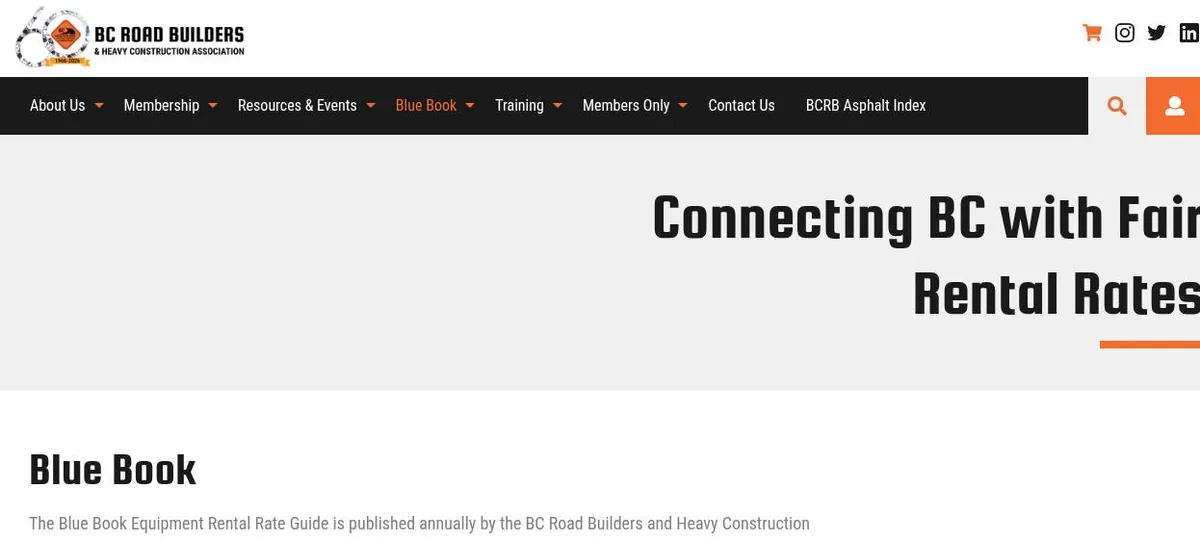
The Blue Book rate has two columns, All Found and Less Operator, so you can be paid with or without your operator. All Found covers the operator, fuel, oil, repairs and maintenance. A few sections are flagged no fuel, where fuel is billed on top and does not qualify for adjustment. Published rates are subject to a monthly fuel adjustment, posted separately, which is the opposite of Alberta’s one-table-for-the-year approach.
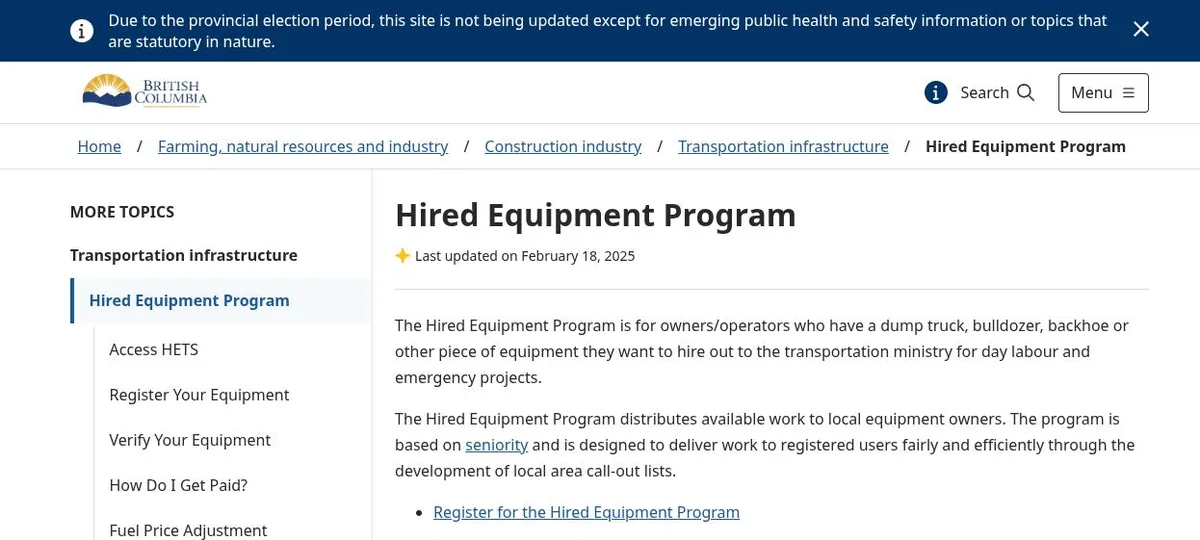
The Hired Equipment Program. If you want Ministry day-labour and emergency work in BC, you register with the Hired Equipment Program in your district. Form H0024 for equipment, H0025 for a dump truck, to the district office’s hired equipment clerk, with proof of ownership, ICBC insurance, general liability before hire, and a WorkSafeBC number. You need to have lived in the district for twelve months, a unit registers in one district only, and you confirm what you have available every year. Call-out runs off local seniority lists, built from years registered plus hours worked in the district over the last three fiscal years. Hired equipment is paid at the Blue Book All Found rate plus the fuel surcharge (maintenance agreement Schedule 4), invoiced on form H1259, with a 30-day payment target that the Ministry says can stretch to 90.
The Ministry’s fuel price adjustment is its own mechanism. Hourly rates move monthly against a base diesel price of $0.94 a litre from the fall of 2009, at 15 litres an hour for on-road equipment and 35 for off-road. For October 2026 that adds $25.50 an hour on-road and $59.50 off-road. Those two numbers tell you most of what you need to know about diesel this year.
The Blue Book is in the spec too. The 2025 Standard Specifications for Highway Construction run a ripping test with a Class 7 or more powerful bulldozer as identified in the Blue Book. Same idea as Alberta’s Group 12.
BC Wildfire Service: a third book, and it excludes fuel
BC Wildfire Service does not use the Blue Book. It publishes its own Equipment Rates and Market Fuel Adjustments, a public PDF updated monthly on the BCWS contract opportunities page, with an archive back to 2020. Two things make it different:
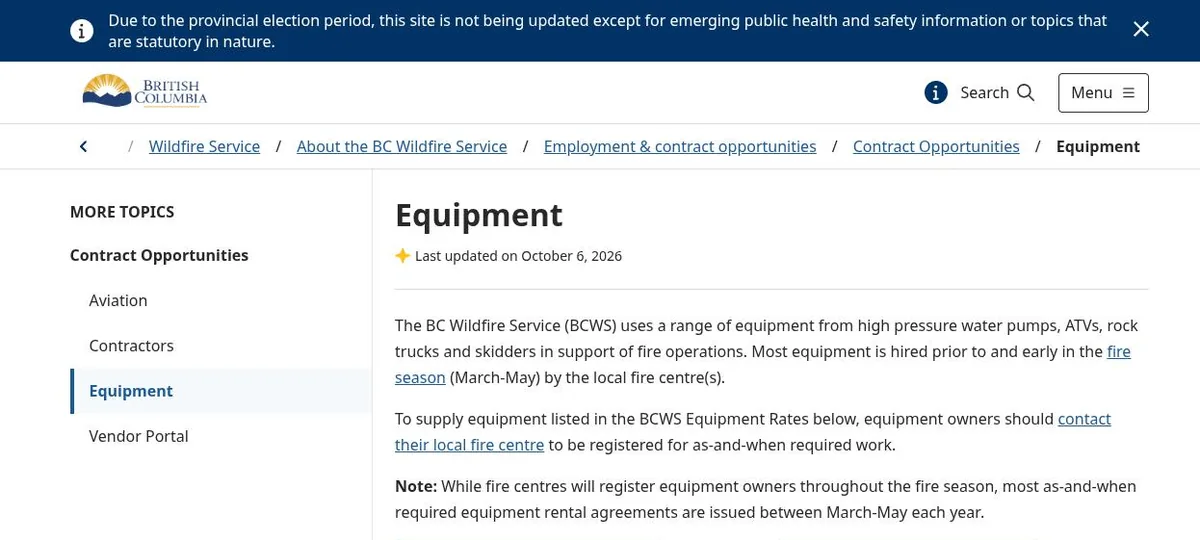
- The All Found rate is equipment and operator with all costs and attachments, excluding fuel and lubricants. In BCWS’s own words, fuel and lubricants are in the Market Fuel Adjustment.
- The Market Fuel Adjustment is a dollars-per-hour figure per equipment class per calendar month, posted within a week of the month starting. You add it to your invoice yourself. It does not apply to standby, and work that spans two months can take the higher month.
An example from the October 2026 issue, the smallest excavator class, under 65,000 pounds and 160 horsepower: all found $206.54 an hour, operator $81.28, and a fuel adjustment of $46.11 in January rising to $86.07 in October. The fuel line nearly doubled inside one season.
To get on the list you contact your local fire centre and register for as-and-when work. Most hiring happens March to May. BCWS also publishes a two-page note on how it builds the hourly rate, fixed costs and variable costs, which is the best free template I know of for building your own rate when nobody hands you a book.
Two more references, and one trap
The Caterpillar Performance Handbook, edition 49, is a free download from several dealers. It is not a rate book. It is where the production and fuel burn figures come from, which is what you need when the question is “what does this machine actually cost me an hour” rather than “what does the book say.”
The BCWS rate-method note, above, is the second.
The trap is the name. There is an American product called the Rental Rate Blue Book, published by EquipmentWatch, and it has nothing to do with the BC Blue Book. If a document out of a Calgary engineering office cites “Blue Book rates” on an Alberta job, ask which one before you price anything.
What I do with this on a bid
Book rates are for extra work, force account and hired equipment. Your own rates are for bidding. The book tells you what the owner will pay when something goes sideways, and that is worth knowing before you sign, because the rate for a 2012 machine in the Previous band is a long way under what a new one earns. On an Alberta highway job, read 1.2.33 before the tender closes, not after the first extra work order. On a BC job, find out whether the owner pays Blue Book All Found, Less Operator, or BCWS, and which fuel adjustment goes with it.
Checked against the ARHCA product page and addendum, the Alberta Transportation and Economic Corridors specifications, the BC Road Builders pages, the Ministry of Transportation and Transit Hired Equipment Program pages and BC Wildfire Service’s October 2026 rate sheet on October 22, 2026. Guide prices are the ones shown that day.
If an extra work order lands and you want it priced and defended against the right book, that is part of the project controls work I do. Fixed fee or hourly, agreed before I start. Project controls.